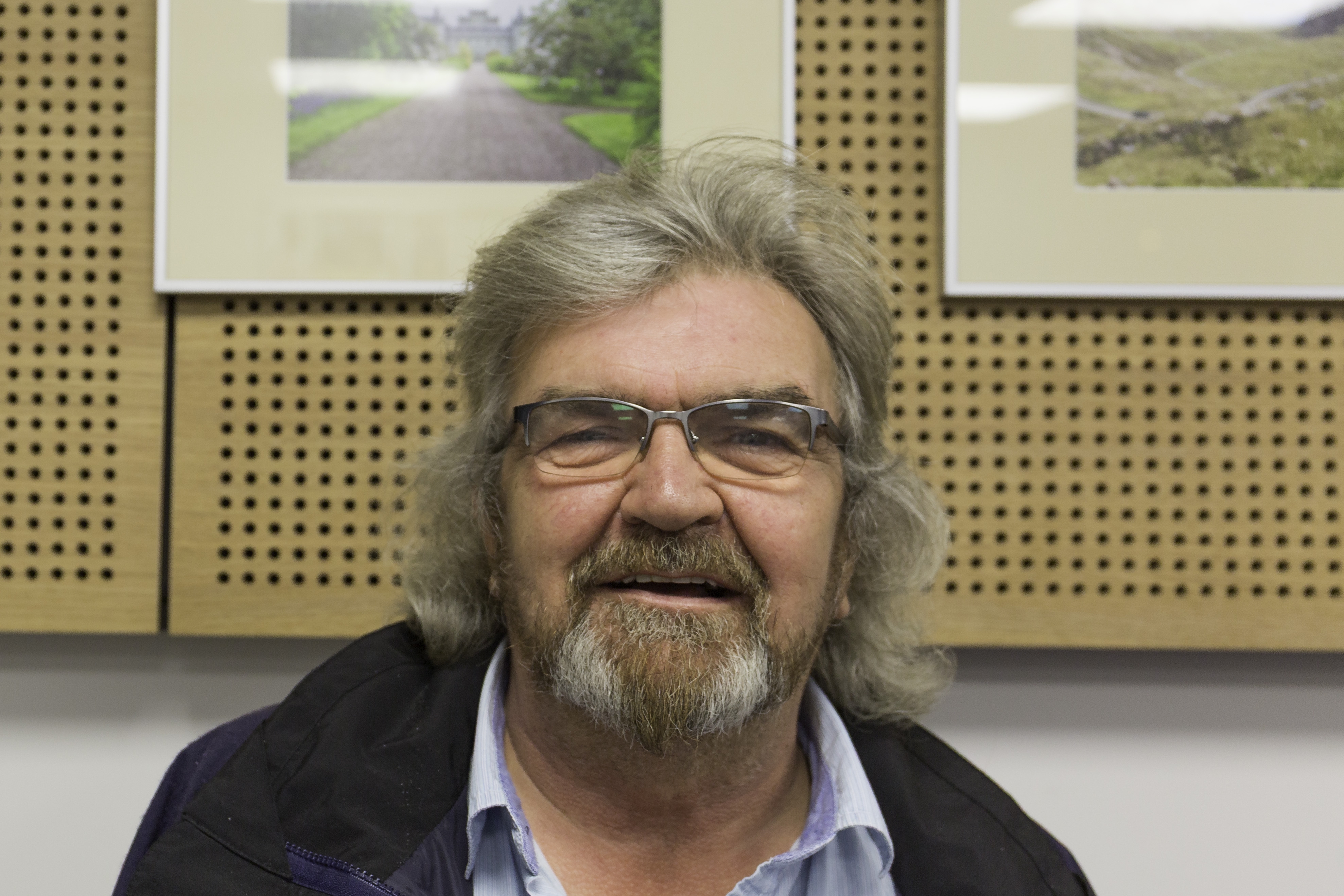
George

Conversation with George and Rafal in the outdoor yard of the club over a few beers. We had arranged to meet two days earlier, when I explained to them what I was aiming to do: introduce these seafarers, who are so close to the city and yet hardly known by it. I had also told George that I was the author of the photographs of the Highlands exhibited in the club. He had recognised a view of Inveraray near his village and showed me his house on his mobile. They both took time to consider my proposal, and they agreed to answer my questions. I do not use any recording device, and I take notes during the conversation.
By way of introduction, I tell them that I will mention only the first letter of their surname, that their vessel will remain unnamed, and that I will avoid questions about their private life, politics or religion. They do not seem especially concerned by that, but it remains my rule in order to protect freedom of speech and the safety of the people I speak with next.
They work on the same vessel, which is dedicated to laying submarine pipelines. There is only one similar vessel in the world, based in the United States. Her missions may last from a few weeks to several years. She operates all over the world.
George and Rafal share similar opinions about their life aboard. They appreciate the living conditions: good food, a choice of three dishes, national dishes on feast days, comfortable cabins with a television and internet access. There are good relations among the members of the crew, which includes more than 200 people of many nationalities. They say they are well paid.
They both say that when the ship is in dry dock for repairs, as is currently the case, the job is harder than at sea where, as they put it, it is only necessary to keep watch and make sure everything is all right. They spend six weeks on board and then have six weeks’ rest. They work shifts from 6 a.m. to 6 p.m. every day of the week, so four shifts follow one another on board.
George C. is 63. He lives in Lochgoilhead, Argyll, Scotland.
He is married and has three stepchildren.
His grandfather was a steward on an ocean liner. He was appreciated by the famous Scottish entertainer Harry Lauder, so much so that he wanted to take him to the United States on tour. When he refused, Lauder found him a job with a wealthy American.
Before going to sea, George had a job in a Rolls-Royce aero-engineering factory, like his father and mother, who had met there. During the Second World War, his father served in the RAF in Palestine.
After Rolls-Royce, he set up a scrap-metal business. In his opinion, the company did not survive because of the huge taxes imposed by the government at that time.
After this setback, he took up what was supposed to be a two-year job on a ship, but in fact he has remained at sea for the last 30 years. He has always worked on ships serving the petroleum industry: a year on a tanker, then on offshore oil-prospecting vessels and pipeline layers. As a result, he has been employed by many international companies such as BP and Stena.
He works as a member of a six-engineer team. His chief engineer joined us later at our table and joked about the on-board “Scottish mafia”. Poor colour vision ruled him out of any piloting career.
His worst professional memory dates from a storm on the North Sea aboard the offshore prospecting vessel Alliance. He was standing near the borehole opening when the ship suddenly heeled. He was almost thrown into the void and thought his last hour had come.
He has so many good memories that he cannot count them. He appreciates the fun and the camaraderie, but in his opinion relationships between colleagues are becoming too serious.
During the last 30 years, he has spent seventeen of them at sea and sixteen at home, so he is looking forward to retiring in January 2018. He wants to “kill work before it kills him”. That does not stop him from thinking about setting up a business making metal doors and fences!