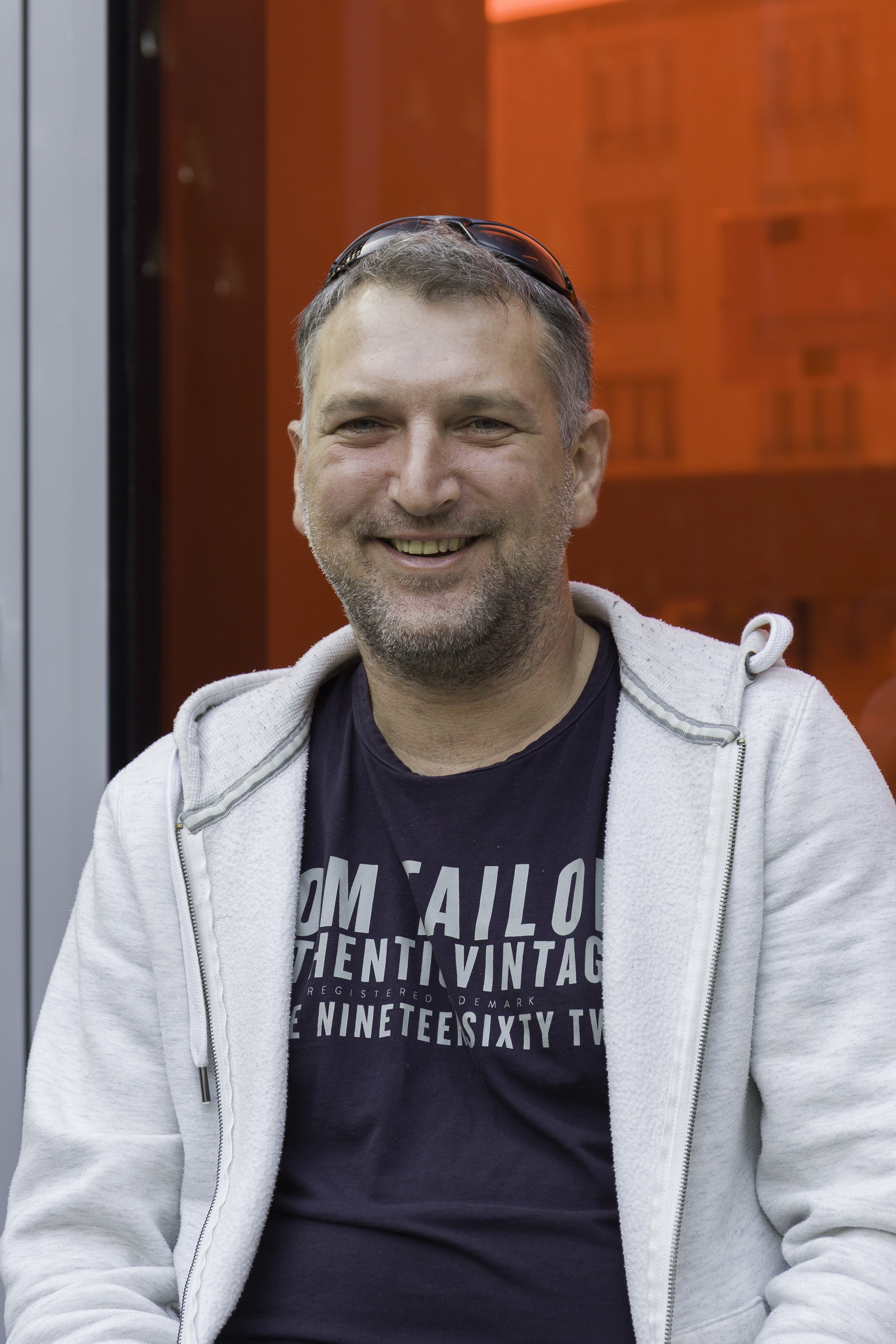
Igor

Igor is 43. He lives in Split, Croatia. He is married to a geography teacher, and they have two boys aged seven and four.
Our relaxed conversation takes place in the outdoor area of the Seamen’s Club. One of his colleagues is with us; the man comes from the same town, but they met through work.
He took a two-year training course in marine electrics. He began to work on ships after his military service, when he was 26. He chose this career and stayed in it because of the earnings.
Before him, some uncles were seafarers, and his brother, who had not reached officer rank, also spent a few years at sea.
He has worked for five maritime companies on all types of vessel and sailed worldwide. The only country he has not visited is Australia, which would be a travel destination for him if it were not so costly.
He has been on board for 20 days on this enormous gas carrier, now in dry dock for the replacement of a propulsion unit. The vessel is icebreaker-shaped. It loads methane in Siberia, which is then delivered to European harbours. The ship came from Montoir. Summer ice melt could alter the ship’s activity and send it towards Asia instead.
He shares the tasks of electrical officer with three other people.
He is satisfied with his work as it is both complex and varied: it ranges from simply changing a bulb to working on complex electronic equipment.
On board, the crew numbers between 40 and 50 at most. They have access to table tennis, a gym, a small swimming pool, television, DVDs and internet.
He copes easily with a working day running from 8 a.m. to 6 p.m., with breaks for meals. He works on board for three to four months and then goes home for a similar length of time.
Every day he is in touch with his family through applications such as WhatsApp. It is sometimes difficult when the ship is far away, at the edge of Siberia. These communications do not create melancholy, especially for his children.
When we come to the pros and cons of his professional life, he says that many changes have occurred over the last 15 years:
- Before, rotations were longer, with calls lasting several days. That enabled him to go ashore, visit the country and enjoy the atmosphere of the harbours. At that time, he was single and had more freedom. He remembers the countries of Latin America as places with poor but welcoming and joyful people. He says, however, that Europe remains his preference.
- Now, technology has shortened the calls, so there are few or no opportunities to go ashore. Computing and the internet have invaded all fields of activity on board. The job is controlled and standardised. It leaves little room for individual initiative. On the other hand, it allows targeted and immediate support if needed. Safety is an obsession, and every task must be formalised. Crews are smaller, and therefore so are the circles of acquaintance. The compensation for this is better profitability.
Among all his voyages, he mentions in particular:
- The atmosphere near New Orleans in 2001 after the attacks on the Twin Towers, when the crew were confined to a lounge for two hours during a police inspection of the vessel with dogs.
- His work on the M/V Sea Launch Commander, registered in Long Beach, California, and dedicated to the control of rocket launches.
- His six-week stays, over three years, on board supply vessels for offshore oil rigs in the North Sea, the Gulf of Mexico, Uruguay and Canada, at Saint John near Signal Hill, where Marconi made his first wireless contact with Europe.
- The sweetness of life in Vietnam.
- The destruction of the bulk carrier he worked on in December 2004 in an Indian harbour during the tsunami in the Indian Ocean: the harbour dikes were submerged by the wave, and the ship drifted for six hours.
- The violence in some ports of call, especially in Brazil.
- The contrast between the few problems ashore and the difficulties at sea when dealing with breakdowns.
Overall, he is happy with his lucrative job, but he feels, in some ways, “like a robot”. His greatest suffering is this family life with its ups and downs, which he considers “unnatural”: time flies, and he “doesn’t see his children growing up”. He feels reduced to the role of provider. That is why he plans, if he can put enough money aside, to buy a second property to rent out. In Split, renting is as expensive as the price per square metre in Paris. In that way, he would have enough income to end his maritime career and begin a new family life.