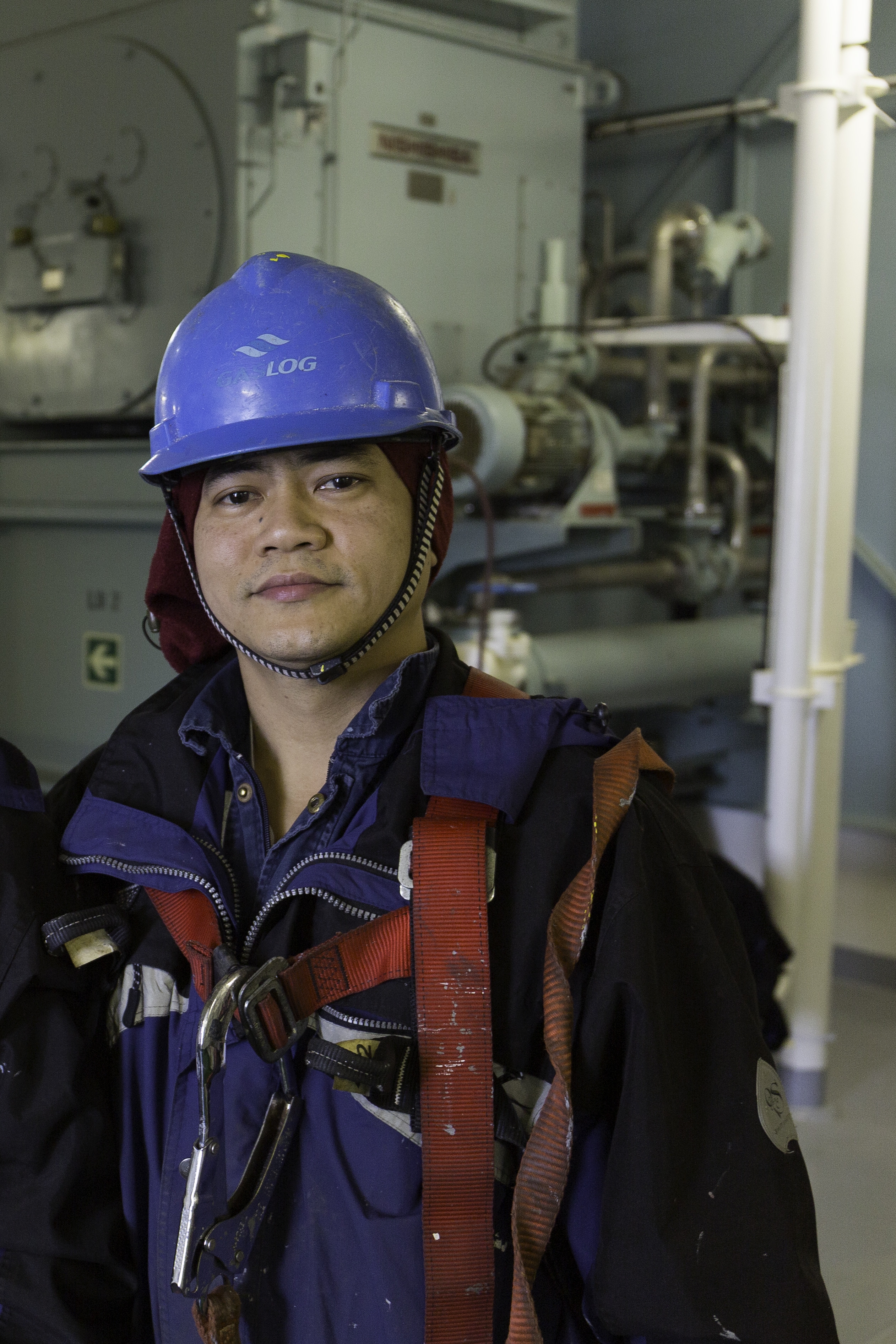
Jequiobob

I met Jequiobob two days ago at the Seamen’s Club, where he had come to buy perfumes. He accepted my proposal for a portrait on board and an interview.
This morning, during the coffee break, we took a group portrait in the crew recreation room and then personal photographs in the compressor room, where he showed me his work as a painter in the ship’s superstructure, hanging from his safety harness.
Our interview takes place that evening in the quiet of the Seamen’s Club lounge while his colleagues celebrate tomorrow’s departure at the bar.
Jequiobob is 38, married, and has two children, a 12-year-old daughter and an 11-year-old son. He lives in Manila in the Philippines. His parents are dead. His closest family is a sister who lives in the provinces and works as a sales representative. There has been no other sailor in the family.
He has worked on ships for 17 years and has had no other profession. He acquired most of his professional skills on the job.
He is currently on a liquefied gas carrier with 32 crew members of three different nationalities: Greek, Ukrainian and Filipino. He has sailed on all sorts of vessels: gas carriers, tankers, cargo ships, bulk carriers and container ships, often with smaller crews of about 21 sailors.
Working periods last six to seven months on board, followed by two to three months of rest at home. He works ten to twelve hours a day, with the heaviest workload when the ship is in port, which is when the maintenance tasks that make up his job are most numerous. Sunday is a rest day. In his free time he has access to many distractions: television, a computer, darts, music and a gym. There is also a library on board where he finds fantasy books that give him a chance to escape. He describes himself as a dreamer, says he sometimes gets bored on board, and admits how much he misses his family.
The ship’s cook serves healthy food with skill, but he says that he also takes supplements and looks after his physical condition because his work demands it. He has to overcome the fear of accidents, especially when working at height, and the fatigue caused by the climate during stays in the oil zones of West Africa.
Relations among the crew are excellent. He values the spirit of solidarity and mutual help, which means people are not afraid to share their problems with one another.
His best moments are when the ship is heading towards the port where he will go home. He imagines that moment in advance. Once he returned home without warning his wife; she was so overwhelmed by his sudden appearance that she dropped the dish she was carrying and burst into tears, begging him never to inflict such a shock on her again. She accompanies him to the airport before every departure and cannot help crying.
When he is ashore, Jequiobob sees some friends but devotes himself mainly to his family. He speaks as if the intensity of his presence could make up for the length of his absences and fight against the admitted feeling that he is sometimes only a provider of money. He takes on as many household tasks as possible and drives the children to school, where he says they are bright and stimulated by the attention of their mother, who oversees their homework. That kind of hyper-presence seems to suit his children, who prefer it to any gifts.
His worst memory is a storm off Cape Town. Four times the ship took a 32-degree list and ended up without propulsion and without electricity, with emergency procedures triggered by the captain. All the equipment, computers, furniture and household appliances were strewn everywhere. Some sailors were injured, some burned by splashes of boiling liquid. He relives the episode in his nightmares.
If he remains healthy, he says a sailor can reach the age of 55 before retirement. He nevertheless dreams of a job ashore, in the United States, Belgium or France, to have a better family life. He pictures himself in a factory or a shop, an opportunity he does not expect from expensive recruitment agencies but rather from his own network of relationships.
We part with mutual thanks: on one side for the sincerity of the exchange, on the other for the willingness to listen.