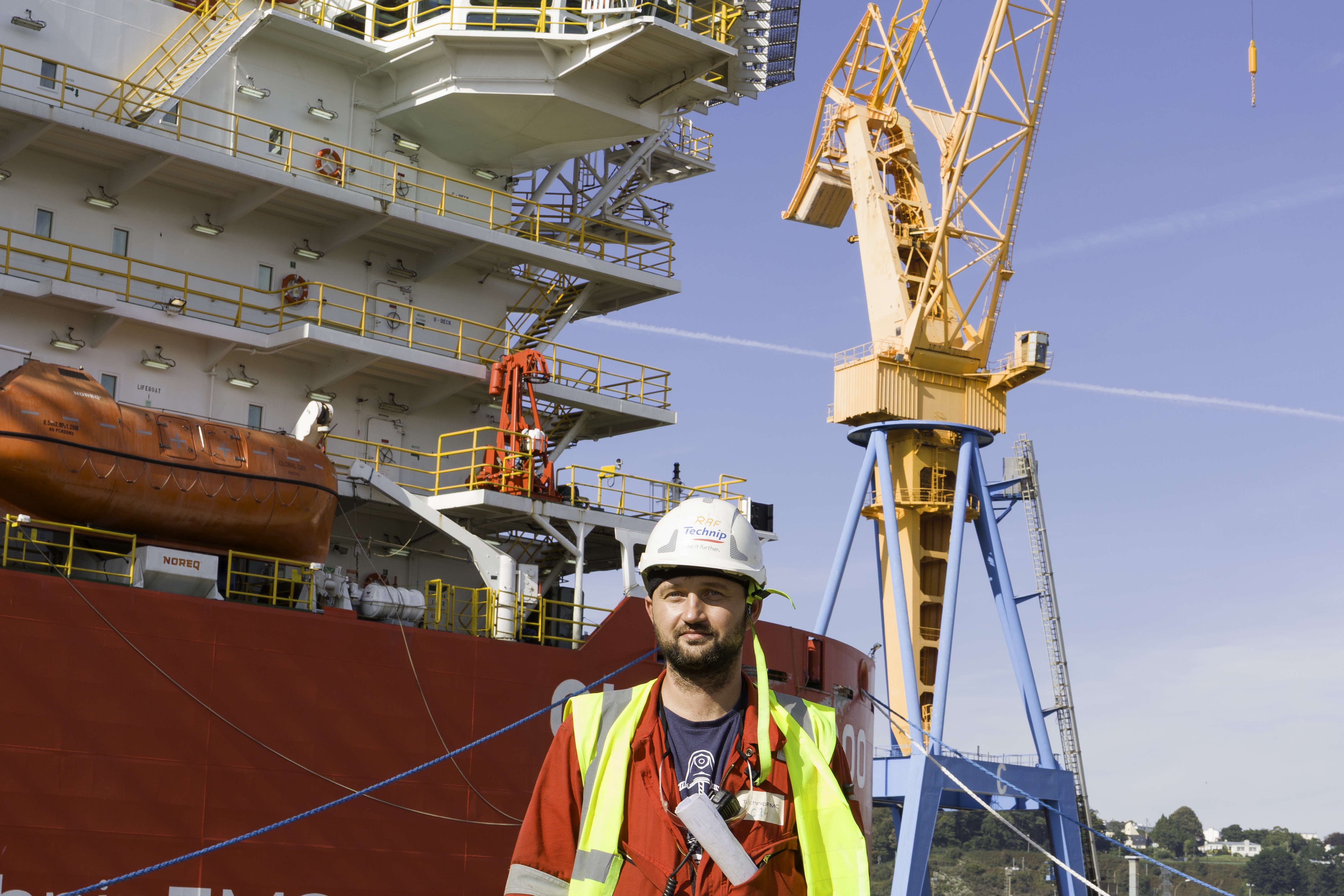
Rafal

Conversation with George and Rafal in the outdoor yard of the club over a few beers. We had arranged to meet two days earlier, when I explained to them what I was trying to do: introduce these seafarers, who are so close to the city and yet hardly known. I had also told George that I was the author of the photographs of the Highlands exhibited in the club. He had recognised a view of Inveraray near his village and showed me his house on his mobile. They both took time to consider my proposal, and they agreed to answer my questions. I do not use any recording device, and I take notes during the conversation.
By way of introduction, I tell them that I will mention only the first letter of their surname, that their vessel will remain unnamed, and that I will avoid questions about their private life, politics or religion. They do not seem especially concerned by that, but it remains my rule in order to protect freedom of speech and the safety of the people I speak with next.
They work on the same vessel, which is dedicated to laying submarine pipelines. There is only one similar vessel in the world, based in the United States. Her missions may last from a few weeks to several years. She operates all over the world.
George and Rafal share similar opinions about their life aboard. They appreciate the living conditions: good food, a choice of three dishes, national dishes on feast days, comfortable cabins with a television and internet access. There are good relations among the members of the crew, which includes more than 200 people of many nationalities. They say they are well paid.
They both say that when the ship is in dry dock for repairs, as is currently the case, the job is harder than at sea where, as they put it, it is only necessary to keep watch and make sure everything is all right. They spend six weeks on board and then have six weeks’ rest. They work shifts from 6 a.m. to 6 p.m. every day of the week, so four shifts follow one another on board.
Rafal S. is 36. He lives in Świnoujście, in Poland, on the Baltic Sea close to the German border.
He is married and has two children: a five-year-old boy and an 18-month-old baby girl. He talks a great deal about her progress in speech and walking.
His father was from inland Silesia. When he died, Rafal was 13. His father had dreamed of becoming a seafarer, but poor health prevented him from pursuing that career. He therefore joined the Army on the coast near the German border. Rafal is aware that he is, in a way, fulfilling his father’s dream.
He studied for five years at a naval school, then for five years at university, and he is now a mechanical engineer. His poor colour vision ruled out any piloting duties.
He has always worked on ships, except for a few student jobs such as working as a waiter. He has known many different vessels with various working conditions.
Despite a demanding pace of work, he considers that he has a good life on board. On this type of ship, he can apply his skills in various fields and carry out different tasks, from simple ones like changing a bulb to more complicated ones. His salary enables him to save money and invest in property for German customers.
His worst memory is of working for seven months on board a ship without going ashore, in very poor hygienic conditions and without being able to contact his family. He was paid 350 dollars a month. By doing overtime paid at one dollar an hour, he managed to earn 100 dollars more.
When he can go ashore, he particularly enjoys staying in a hotel for two days and visiting the place.
For the future, he dreams of setting up a ship-repair company with a colleague with whom he studied.
He longs to go back home where, like his colleague George, his sleep is disturbed only by the stopping of an electrical appliance, for, as they say, “if it is silent, something is wrong”.